
The best Clay alternatives in 2026, sorted by what you actually need
Clay does three jobs in one product: it pulls in data from 200+ providers, runs an agent over every row, and pushes the result into a sequence. Most people searching for a Clay alternative only need one of those three, so this list is sorted into four lanes rather than one flat ranking. Pick the lane that matches the part of Clay you actually use, and the shortlist inside it does the rest. I built the tool in the fourth lane, which is why it sits there rather than at the top of the page.
What does Clay actually do?
Clay describes itself as “Infrastructure to get any data, run agentic workflows, and launch GTM plays”, built around a spreadsheet-style table, a data marketplace of more than 200 providers, AI research agents it calls Claygents, and a sequencer to launch the result. Its own pricing page, read on 26 September 2026, lists Free at $0 a month with 500 actions and 100 data credits, Launch from $167 a month, Growth from $446 a month, and a custom Enterprise tier. Every plan carries a 14 day trial that takes no card to start.
That breadth is exactly why one alternative rarely replaces it outright. A team that outgrows Clay is usually outgrowing one of its three layers, the data, the workflow, or the sending, not all three at once, which is why this page is organized by lane rather than as ten competitors racing for the same rank.
Eight tools, side by side
Entry prices as published on 26 September 2026, or stated as not published where the vendor keeps them behind a sales call or a client-rendered widget. Rows run lane by lane, in the same order as the cards further down.
| Tool | Best for | Key capability | Price | Free tier or trial |
|---|---|---|---|---|
| n8n | Teams who already have a data source and want to automate what happens to each row, without paying for a bundled data marketplace. | Visual workflow automation with a free self-hosted Community edition and a paid cloud tier. | 20 euro a month billed annually for Cloud Starter, 2,500 executions a month | Free, self-hosted Community edition on GitHub. Cloud plans carry a free trial with no card required. |
| Apollo.io | Teams who want the database, the enrichment and the sending in one subscription rather than three. | Contact database, enrichment and outreach sending in one product, with 200+ integrations. | Not published in static page text as of 26 September 2026; third-party sources report roughly $49 to $119 a seat a month on annual billing | A free Starter tier exists, and paid plans include a trial with 50 credits and 5 mobile credits. |
| Lusha | Anyone who wants a contact database with a real price on the page, not a sales call. | Published, self-serve pricing with a credit system that rolls over unused credits. | $49.90 a month for Starter, 400 credits a month, or $37.45 a month billed annually | Free tier with 40 credits a month. |
| Cognism | Sales teams in regulated markets who need verified mobile numbers and are already used to buying data on a contract. | Phone-verified mobile data and intent data layered on top of a standard contact database. | Not published. Every tier's price is behind a sales conversation. | None published. Every CTA on its pricing page reads "Talk to sales" or "Book a demo." |
| ZoomInfo | Larger sales and marketing organizations already set up to negotiate an annual data contract. | Database breadth and depth at enterprise scale, with intent and org-chart data layered on top. | Not published. Both zoominfo.com and its pricing page returned HTTP 403 to a direct fetch on 26 September 2026, and the vendor is well known for selling only through a custom sales quote. | None published. |
| Warmly | Teams with real inbound website traffic who want to know who just showed up before that visitor leaves. | Turns an anonymous website visit into a named contact and company in real time. | $10,000 a year for AI Web-Deanonymization, billed annually, from 10,000 credits a month | None shown on its pricing page. No trial length is published either. |
| Common Room | Teams that already track community and social engagement and want job-change and intent signals added to the same record. | Combines job-change, community-engagement and third-party intent signals in one contact record. | $2,500 a month billed annually for Essential, 5 seats, up to 100,000 contacts | None published. Advanced and Enterprise tiers are both quote-only. |
| EaseClaw our product | Founders and small B2B teams doing their own selling, with one connected LinkedIn account and no SDR. | Finds the person from a signal and writes to them, in one product, rather than handing a row to a separate sender. | $99 a month for Pro | Free for 7 days, no card required. Pick a plan on day seven to keep going. |
Which of the four lanes is your Clay problem?
Most bad purchases here are lane mistakes: buying a database when the real gap was a workflow tool, or buying a signal platform when a founder just needed one channel handled end to end.
The eight tools, lane by lane
One card per tool: what it does, the entry price, who it fits, one real strength and one real weakness, each checked against the page linked at the foot of the card.
Best for data enrichment and workflow automation
A workflow automation platform, open source at its core, that wires data sources, AI steps and destinations together in a visual builder. It is the closest thing here to Clay's own execution layer without Clay's own data marketplace built in.
A combined contact database, enrichment layer and outreach sender, sold as what its own home page calls "The AI GTM System for Go-to-Market Teams," built around a 240 million person contact database and an AI agent layer for research and follow-ups.
Best for company and contact databases
A contact database sold on a credit system: one credit reveals a verified email, five reveal a phone number, and unused credits roll over up to twice the plan limit.
A contact and company database aimed at compliance-heavy sales teams, with mobile numbers, intent data and CRM enrichment sold as separate lines rather than one flat plan.
One of the largest B2B contact and company databases sold to enterprise sales and marketing teams, bundled with intent data, org charts and a CRM enrichment layer.
Best for buying-signal and intent tools
A website visitor identification and intent tool: it de-anonymizes who is on your site, adds an AI chat layer on top, and can route a warm visitor into email, LinkedIn or ad retargeting.
A buyer intelligence platform that tracks job changes, community and social engagement, and website activity, and layers on Bombora's Company Surge intent topics.
Best for founder-led LinkedIn outreach
An AI agent for LinkedIn outreach. It reads your website, works out who should buy from you, finds those people on LinkedIn from signals such as competitor engagement or a job change, and writes the invite and the follow up in your voice.
If the lane you landed in is the fourth one, the two pages that go with it are the guide to buying intent signals, which explains the kind of signal an outreach agent works from instead of a static database row, and the guide to LinkedIn cold outreach, which covers what to send once that signal has found somebody. The Gojiberry comparison is worth a look too if you are choosing between two agents that both work this way rather than between an agent and a database.
How much does each Clay alternative cost?
Every figure below was read on 26 September 2026, from the URL in its row. Two rows say plainly that no price is published: Apollo's grid renders in the browser rather than in static page text, and ZoomInfo's pages returned HTTP 403 to a direct fetch, which is consistent with it selling only through a custom quote.
| Tool | Plan | Price | What it buys | Billing | Read on |
|---|---|---|---|---|---|
| n8n | Cloud Starter | 20 euro | per month billed annually, 2,500 workflow executions a month | monthly, billed annually | 2026-09-26 |
| n8n | Cloud Pro | 50 euro | per month billed annually, 10,000 workflow executions a month | monthly, billed annually | 2026-09-26 |
| Apollo.io | All paid tiers | Not published in static text | the pricing page renders its plan grid client side | not readable directly | 2026-09-26 |
| Lusha | Starter | $49.90 | per month, 400 credits a month, or $37.45 a month billed annually | monthly or annual | 2026-09-26 |
| Cognism | Standard and Pro | Not published | every tier is priced on a sales call | contact sales | 2026-09-26 |
| ZoomInfo | All tiers | Not published | zoominfo.com and its pricing page returned HTTP 403 to a direct fetch | contact sales | 2026-09-26 |
| Warmly | AI Web-Deanonymization | $10,000 | per year billed annually, from 10,000 credits a month | annual | 2026-09-26 |
| Common Room | Essential | $2,500 | per month billed annually, 5 seats, up to 100,000 contacts | monthly, billed annually | 2026-09-26 |
| EaseClaw | Pro | $99 | per month, one LinkedIn account per member | monthly | 2026-09-26 |
| EaseClaw | Business | $199 | per month, one LinkedIn account per member | monthly | 2026-09-26 |
What a warm LinkedIn list costs, measured on our own outreach
Clay's own scale is easy to state: 200+ data providers, by its own count, read from clay.com on 26 September 2026. What is harder to find anywhere is what happens after the table is built, so here is our own ledger for the one lane on this page that ends in a sent message rather than an enriched row.
The 17% is the number worth carrying into any of the eight tools above. Pulling the people behind a signal or a search is the cheap part, about a quarter of a cent each in our own ledger. Roughly one in six of them turned out to be another vendor selling into the same room, and removing those by hand is the tax nobody quotes you for, whichever tool built the table. The full ledger, with the date each figure was read:
- Clay's own published data provider count: 200+ providers in its data marketplace. Source: clay.com, read 2026-09-26, as of 2026-09-26.
- Competitor and creator posts we pulled the engagers from: 44 posts from 14 creators. Source: EaseClaw harvest ledger, marketing/harvests/engager-ledger.json, as of 2026-09-08.
- Those engagers who were vendors selling a rival tool: 286 of 1,672, or 17%. Source: EaseClaw harvest ledger, people marked as vendors, as of 2026-09-08.
- What it cost us to pull 1,434 engager profiles: $3.37, about a quarter of a cent per person. Source: EaseClaw harvest ledger, counters for 2026-08-06 to 2026-08-10, as of 2026-08-10.
- Posts read before 125 genuine buyers came out of them: 34,116 read, 5,789 scored, 125 buyers. Source: easeclaw.com/research/buying-intent-2026, as of 2026-08-04.
The wider view is on our buying-intent research page: 34,116 posts read, 5,789 scored, 125 people who turned out to be genuine buyers, as of 4 August 2026.
Where does EaseClaw actually fit on this list?
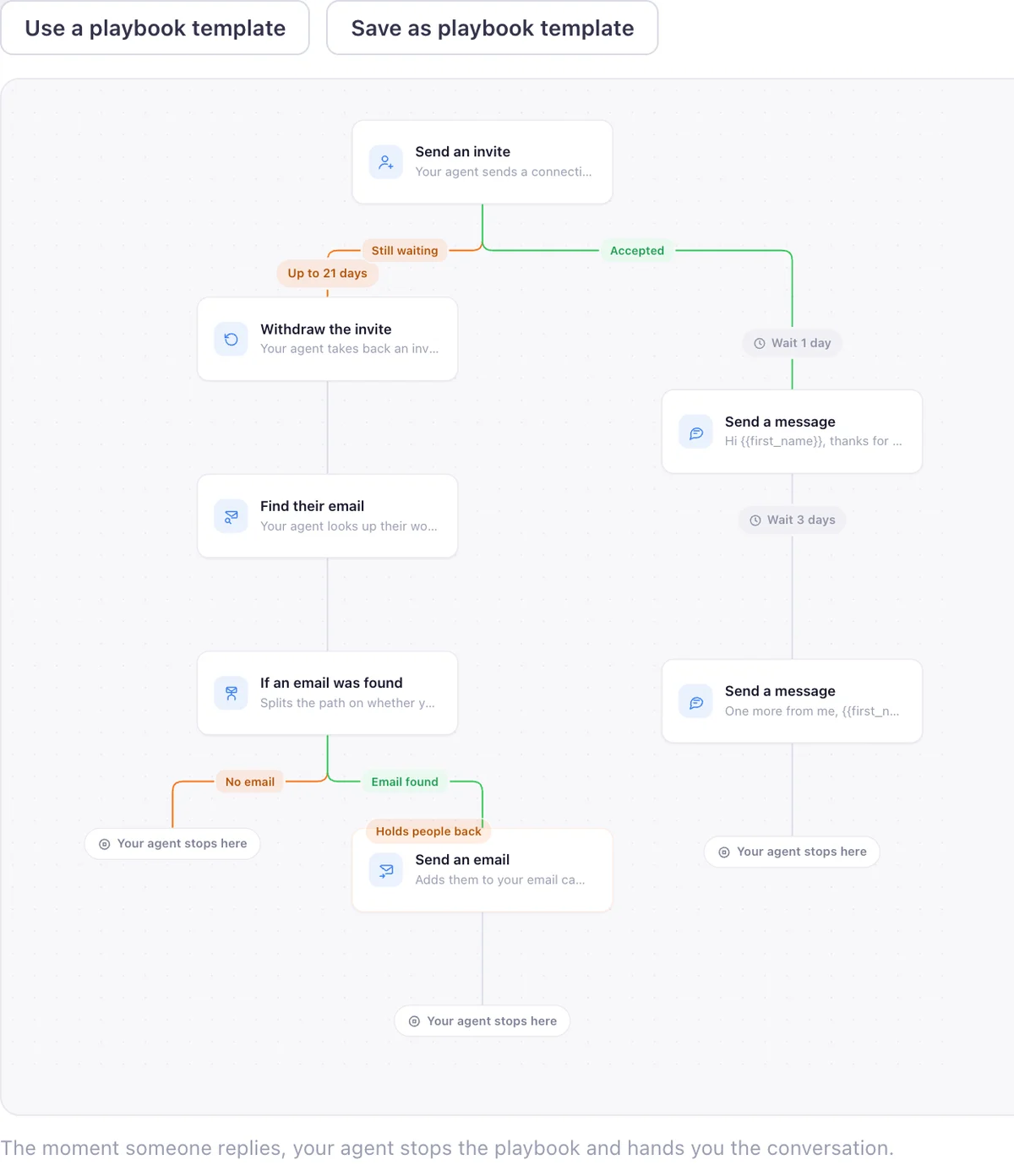
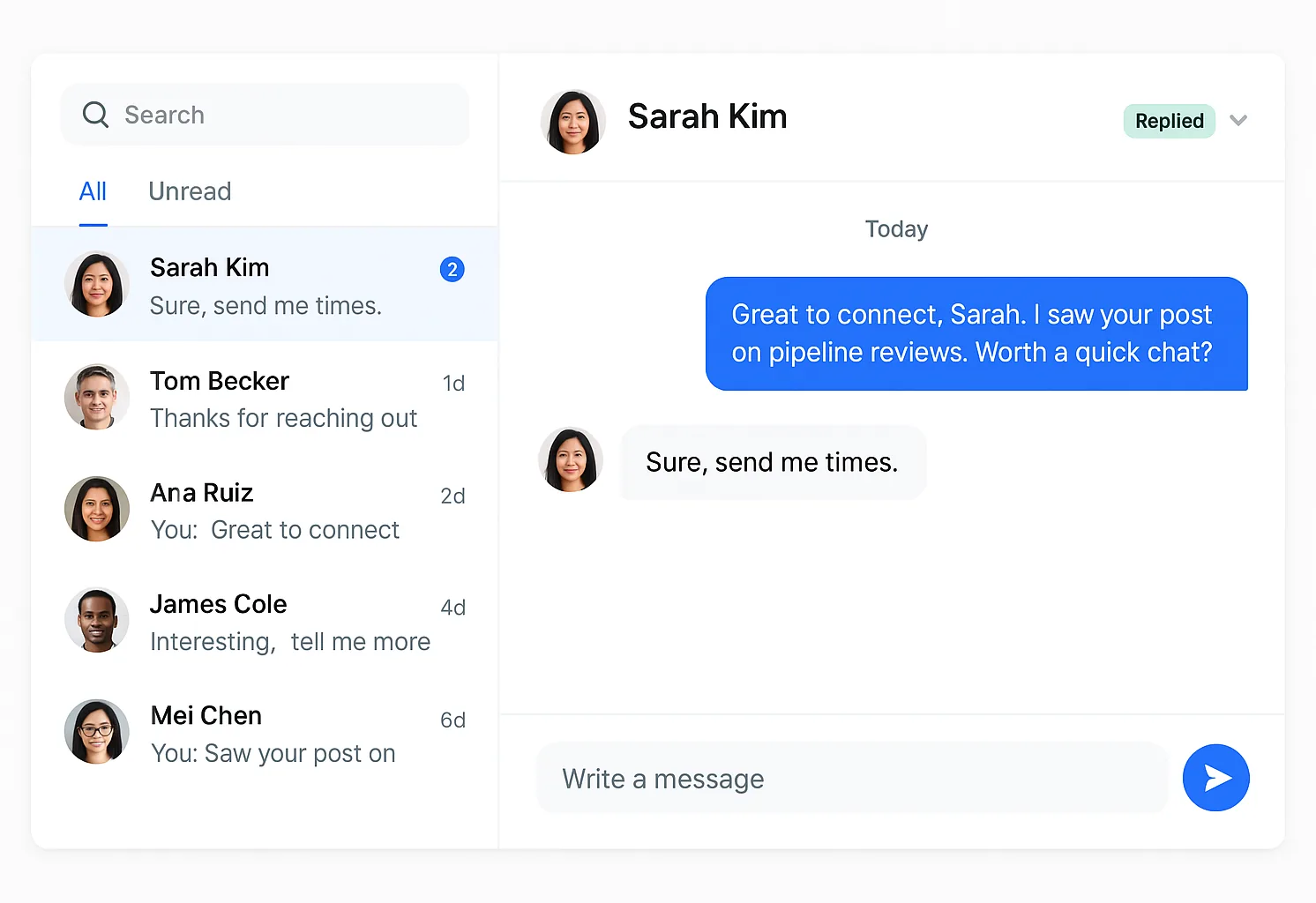
Since I built one of these eight, here it is in the same words the rest of the site uses. EaseClaw is the AI agent that finds warm buyers on LinkedIn and runs outreach for founder-led B2B companies, without building prospect lists by hand. Built for founders and small B2B sales teams selling high-value products or services, especially when there is no dedicated SDR. You paste your website, it works out what you sell and who should buy it, then finds those people through LinkedIn signals: engagement on a competitor’s posts, a job change, someone asking for a recommendation, a company hiring for the problem you solve. It writes the invite and the follow up in your voice, waits for the accept, sends the first message, and keeps every reply in one inbox.
It has no data marketplace, no workflow builder, and it will not enrich a table you already built somewhere else. If your Clay table currently ends in a LinkedIn campaign, EaseClaw is a real replacement for that last step. If it ends in a cold email sequence built from fifteen enriched fields, buy one of the other seven instead.
Where the other seven are better than EaseClaw
Three things the tools above do that EaseClaw does not do at all. If any one of them describes the gap you are trying to fill, buy the tool that fills it and stop reading here.
Company and contact databases, website visitor identification, community engagement signals, workflow automation across any data source you connect: none of that is what EaseClaw does. If the job is building a table of 50,000 companies with fifteen enriched fields each, every other tool on this page is closer to the job than an outreach agent that looks at LinkedIn alone.
Clay's own pricing page advertises 200+ data providers behind its waterfall enrichment, and tools like Lusha, Cognism and ZoomInfo are the kind of provider a Clay table pulls from. Replacing Clay with a narrower workflow tool such as n8n still leaves the question of which data source feeds it, and EaseClaw does not answer that question at all.
Warmly and Common Room both price above $2,500 a month for their published tier, and what that buys is a wider signal set than EaseClaw's: website visits, community engagement, Bombora intent topics. A team with that budget and that need is buying more surface area than a single-channel LinkedIn agent is built to cover.
Questions people ask before switching off Clay
What is the best Clay alternative?
Is there a free alternative to Clay?
What is cheaper than Clay?
Does any Clay alternative also send the outreach, not just find the data?
I only need buying signals, not a whole workflow platform. What should I use instead of Clay?
Can EaseClaw replace Clay for my outreach?
Which of these tools has the most transparent pricing?
What EaseClaw looks like
Our product, so you can see what the agent actually runs. Screens from the real app with demo data, and one illustration, labelled as such.
If your table always ended in a LinkedIn campaign anyway
Skip the table. Paste your website, and the agent finds the people on LinkedIn who are already showing they want what you sell, then writes to them in your voice. Seven days free, no card, then pick a plan to keep going.