
Buska alternative: watching everywhere, or writing to one channel
EaseClaw is the AI agent that finds warm buyers on LinkedIn and runs outreach for founder-led B2B companies, without building prospect lists by hand. Built for founders and small B2B sales teams selling high-value products or services, especially when there is no dedicated SDR. Buska is the wide end of the same ambition: it watches more than twenty public places for people describing a problem, sorts them by how hot they look, and drafts what to say. This page is the honest version of the choice. I have not run Buska, and every fact about it below was read from buska.io and its pricing page on 15 September 2026, with the page it came from linked beside it.
Free for 7 days. Add a card to start, cancel any time before day 7 and you pay nothing.
What Buska is, in its own words
The home page headline is “Buska finds the people who need your product”, and the pricing page puts the category plainly: “Buska is a social listening platform built for lead generation.” It lists a long set of places it reads, including Reddit, LinkedIn, X, Hacker News, Quora, GitHub, Stack Overflow, Trustpilot, Capterra, Product Hunt, Indie Hackers, app stores, forums and the open web.
What it does with a match is the part worth reading twice. It sorts findings into “HOT, WARM or EXPLORE” rather than counting mentions, alerts you by “Slack, Discord, email or webhook the minute a HOT lead lands”, and its Reply Studio gives “a contextual draft in seconds, in a peer, expert or founder tone”.
One correction to the version of this page that stood here until 15 September 2026, which called Buska our closest twin and stopped at the draft. Buska’s Scale plan adds an “AI SDR Agent: hunts, drafts and sends outreach for you”, which its home page introduces with “It is not a feature. It is a sales hire who happens to be software.” The approval step is time-limited rather than permanent: “Once it has 8 approved sends, autopilot becomes available and stays off until you switch it on.” And the channel it sends on is email, from your own mailbox: “It sends from your inbox”, with “It writes from its own mailbox, or from yours over SMTP, with your signature.” That is a real product doing a real version of the job this page is about, and any comparison that leaves it out is selling you a smaller Buska than the one that exists.
What Buska and EaseClaw cost
Read from buska.io/pricing on 15 September 2026. The date in the last column links the exact page each number came off. Buska also advertises a “7-day free trial, no credit card required” and says annual billing “saves you 2 months (about 17%)”.
| Tool | Plan | Price | What it buys | Billing | Read on |
|---|---|---|---|---|---|
| Buska | Starter | $49 | per month, the cheapest of three published tiers | monthly | 2026-09-15 |
| Buska | Growth | $99 | per month, the tier the pricing page marks "Most popular" | monthly | 2026-09-15 |
| Buska | Scale | $249 | per month, the tier that adds the AI SDR agent | monthly | 2026-09-15 |
| Buska | Agency | No public price | multi-brand, dedicated account manager, volume discounts | contact sales | 2026-09-15 |
| Buska | Developer API credits | $50 | for 1,000 credits, bought separately from the subscription | prepaid credits | 2026-09-15 |
| EaseClaw | Pro | $99 | per month, one LinkedIn account per member | monthly | 2026-09-15 |
| EaseClaw | Business | $199 | per month, one LinkedIn account per member | monthly | 2026-09-15 |
The interesting rows are at the two ends. Buska starts at half our price, which makes it the cheaper way to find out whether anybody anywhere is describing your problem. Its Scale tier then goes above ours, because that is where the sending agent lives. On our side the whole menu is two numbers and there is nothing behind a call: Free for 7 days. Add a card to start, cancel any time before day 7 and you pay nothing.
EaseClaw compared with Buska, row by row
Seven rows. Each Buska cell links the page it was read from on 15 September 2026. Read the rows where we come off worse as carefully as the rest, because on breadth we lose badly and that is the point of putting them here.
| Buska | EaseClaw | |
|---|---|---|
| What it calls itself | "Buska is a social listening platform built for lead generation", with the home page headline "Buska finds the people who need your product." | An AI agent for LinkedIn outreach. It works out who is worth writing to from your own website, writes the invite and the follow up in your voice, and runs them inside the campaigns and limits you set. |
| Where it looks for people | A very wide net, listed on the home page as Reddit, LinkedIn, X, Hacker News, Facebook, Instagram, TikTok, Quora, YouTube, Bluesky, GitHub, Substack, Medium, Stack Overflow, Trustpilot, Capterra, Product Hunt, Indie Hackers, app stores, forums and the open web. | LinkedIn, and deliberately only LinkedIn. People who engaged with a competitor's post, changed job, asked for a recommendation, or work somewhere hiring for the problem you solve. |
| How it decides what reaches you | Intent tiers rather than a raw mention count: it sorts what it finds into "HOT, WARM or EXPLORE", and will alert you by "Slack, Discord, email or webhook the minute a HOT lead lands." | A picture of your ideal customer, built from your website and edited by you. Anybody who does not match it is dropped before a message is ever drafted, which is the step that decides everything downstream. |
| What it writes | Reply Studio, which gives "a contextual draft in seconds, in a peer, expert or founder tone". You take that draft and post it where the conversation is. | The LinkedIn invitation and the first message after it is accepted, written per person from the signal that surfaced them, plus drafts for public threads that you post yourself. |
| What it sends, and from where | Its Scale plan adds an "AI SDR Agent: hunts, drafts and sends outreach for you". The approval step is temporary: "Once it has 8 approved sends, autopilot becomes available and stays off until you switch it on." The channel is email, and "It sends from your inbox". | LinkedIn invitations and messages from your own connected account, plus an email step that sends from your own mailbox, all inside a campaign you configured. Review every message, or let it run. |
| What the entry plan costs | $49 a month for Starter, $99 for Growth, $249 for Scale, and a custom Agency tier described as multi-brand with a dedicated account manager. Annual billing is advertised as saving about 17%. | $99 a month for Pro and $199 for Business, monthly only, with nothing behind a sales call and no bigger tier to be upsold to. |
| What you can build on top | Prepaid API credits sold separately from the subscription: $50 for 1,000, $500 for 50,000 and $3,000 for 500,000, so the feed can drive something you built yourself. | An MCP server, a REST API and a CLI, included rather than metered as credits. The machine surface reads and drafts. It does not send. |
Where Buska is better than EaseClaw
Four things, checked against buska.io on 15 September 2026. If two of them describe your week, buy Buska and stop reading.
Buska's home page lists more than twenty sources, from Reddit and Hacker News to Trustpilot, Capterra, app stores and the open web. EaseClaw looks at LinkedIn. If the people who buy from you gather in a subreddit, a forum or a review site, Buska will find them and we will not even look, and no trial of ours is going to change that this quarter.
Trustpilot, Capterra and the app stores are on Buska's list, and for a product with direct competitors that is a genuinely good place to find somebody unhappy enough to switch. It is also a category of signal EaseClaw has no route to at all. If competitor review mining is the motion you want to run, Buska is the tool that runs it.
Starter is $49 a month against our $99, and Buska advertises a seven day free trial with no credit card required, where ours takes a card at sign-up and charges nothing until day seven. If the question is how little you can spend to find out whether anyone is talking about your problem anywhere, Buska answers it for half the money, and this page is not going to pretend otherwise.
The Scale plan adds an AI SDR Agent that hunts, drafts and sends outreach for you, and its own page says autopilot unlocks after eight approved sends, so Buska can close the loop from a public signal to an email without you. EaseClaw has an email step too, and it also sends from your own mailbox, but as part of a LinkedIn-led campaign. If email is your main channel and the signal is coming off a forum rather than LinkedIn, their shape fits yours better than ours does.
Which one is actually right for you
- Your buyers are on LinkedIn and you already know it.
- You are the person selling, and you run one LinkedIn account.
- Deciding who is worth writing to is the part that eats your week.
- You want the invite and the follow up written per person, in your voice.
- You want replies in one place with the outreach that produced them.
The worked example: EaseClaw for MSP founders. An IT services owner with fifteen staff and no SDR pastes the company site, and the agent works out that the people worth writing to are operations leads at companies hiring their first internal IT person. One account, one person approving, meetings as the number that matters. The method is free to read in the warm lead system.
- Your customers complain in forums, subreddits or review sites.
- You want competitor reviews on Trustpilot and Capterra read for you.
- Email is your main channel and the signal comes from outside LinkedIn.
- You run outreach for several brands or clients.
- You want a feed of scored signals to drive something you built yourself.
Those are real gaps on our side and a trial of ours will not close them. If you are weighing the wider category rather than these two, the guide to buying intent tools puts eight of them side by side with prices read the same day as this page.
Moving from Buska to EaseClaw, step by step
- Decide whether you are actually moving. If more than a third of your hot leads come from somewhere other than LinkedIn, do not move, or keep both. This is the step most migration guides skip because it is the one that sometimes ends the migration.
- Export your people before you cancel, so the ones Buska already found stay yours. Take the LinkedIn profile URL where there is one, the name, the company and the reason each person surfaced.
- Import them at /leads/people. That page takes a CSV of people and is the only door prospects come in through by hand. Map the profile URL first; without it a row is a name rather than a person the agent can write to.
- Paste your website and read the profile back. The agent writes what you sell and who should buy it in plain sentences. Edit them. Everything downstream, including who gets skipped, follows from those two paragraphs.
- Rebuild your best Reply Studio opener as a first message. The tone carries across even though the format does not: a Buska draft answers a public post, and an EaseClaw first message opens a private conversation after an invitation is accepted.
- Connect LinkedIn and read the first batch before it goes. Correct what reads wrong, and once the drafts stop needing edits, stop reading them. Review every message, or let it run.
One thing does not move: nothing here reads Trustpilot, Capterra, app stores or forums, so any workflow built on those sources has to stay where it is or be dropped.
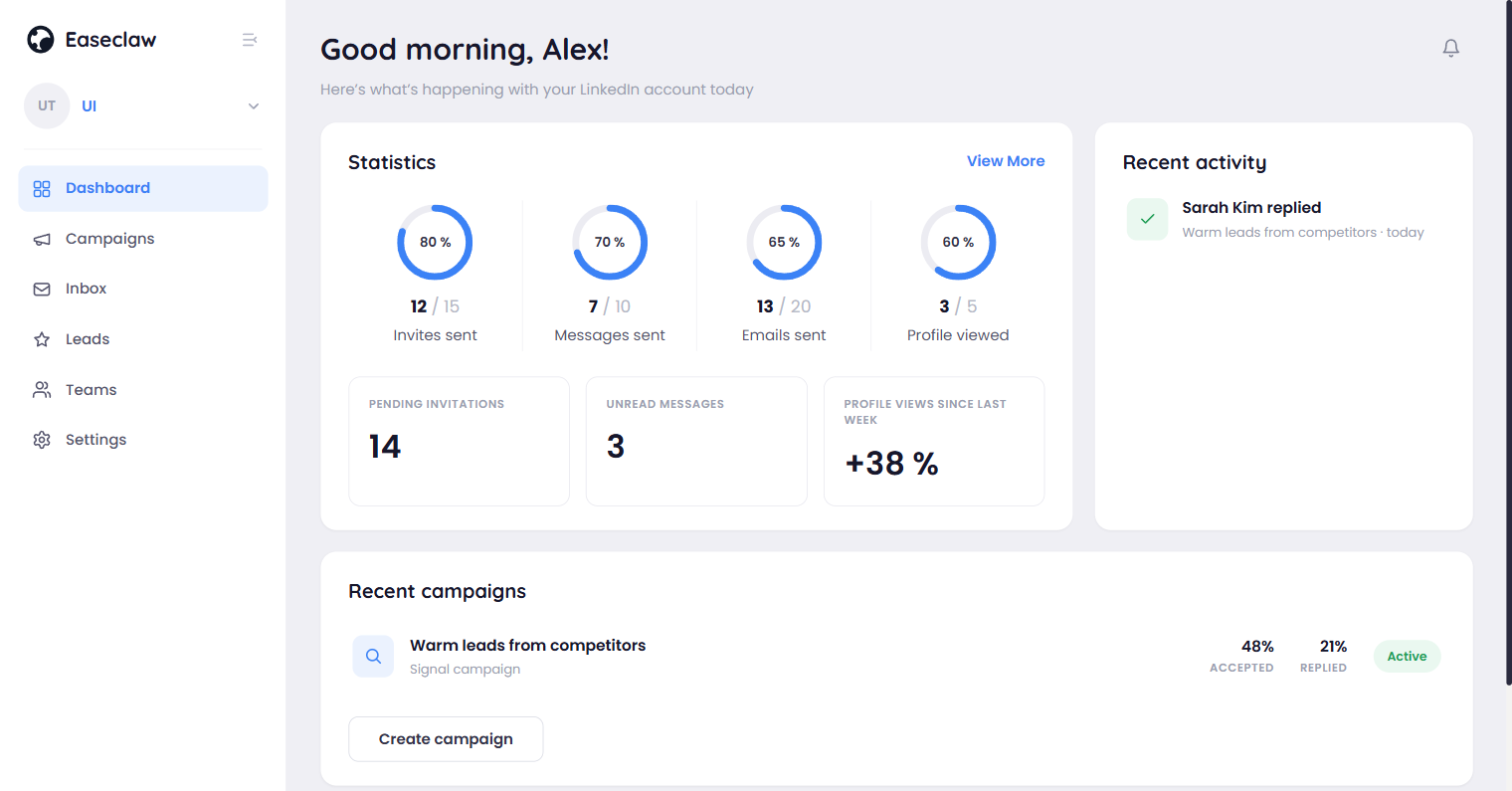
What EaseClaw looks like
Our product, shown with example data. There are no Buska screenshots anywhere on this page, because I have not run it, and a screenshot would imply I had.

What a warm list costs, measured on our own outreach
Figures from our own ledger, not an industry study, and not a promise about what your campaigns will do. They are here because they answer the question both products are really selling an answer to.
The 17% is the interesting one. Pulling the people who gave off a public signal is cheap, about a quarter of a cent each, and it is not the hard part. Roughly one in six turned out to be another vendor selling into the same room, and removing those by hand is the tax nobody quotes you for. Both products exist to do that removal before a message is drafted, which is why the picture of your ideal customer matters more than the breadth of the net. The full ledger, with the date each figure was read:
- Unique people behind the public signals we pulled: 1,672 from 44 posts by 14 creators. Source: EaseClaw harvest ledger, marketing/harvests/engager-ledger.json, as of 2026-09-08.
- How many of them sold a rival product: 286 of 1,672, or 17%. Source: EaseClaw harvest ledger, people marked as vendors, as of 2026-09-08.
- What pulling those profiles cost us: $3.37 for 1,434 profiles, about a quarter of a cent each. Source: EaseClaw harvest ledger, counters for 2026-08-06 to 2026-08-10, as of 2026-08-10.
- Posts we read before a genuine buyer came out: 34,116 read, 5,789 scored, 125 buyers. Source: easeclaw.com/research/buying-intent-2026, as of 2026-08-04.
The wider view is on our buying-intent research page: 34,116 posts read, 5,789 scored, 125 people who turned out to be genuine buyers, as of 4 August 2026. Real buyers are rare, which is the whole reason a tool that picks the people is worth more than a tool that shows you all of them.
Questions people ask before switching
Is EaseClaw a good Buska alternative?
How much does Buska cost compared with EaseClaw?
Does Buska send messages for you?
Does EaseClaw post replies to public threads?
Can I use both?
I run outreach for several clients. Which one?
Stop building lists. Start meeting buyers.
AI outreach for founder-led B2B teams. No lists. No SDR.
Free for 7 days. Add a card to start, cancel any time before day 7 and you pay nothing.