
Gojiberry alternative: one agent, one founder, one connected account
EaseClaw is the AI agent that finds warm buyers on LinkedIn and runs outreach for founder-led B2B companies, without building prospect lists by hand. Built for founders and small B2B sales teams selling high-value products or services, especially when there is no dedicated SDR. Gojiberry is the closest thing to it on the market: an AI go-to-market agent that finds people from buying signals and writes to them across LinkedIn and email. This page is the honest version of the choice. I have not run Gojiberry myself, and every fact about it below was read from gojiberry.ai and its FAQ on 15 September 2026, with the page it came from linked beside it.
Two products share this name. This page is about gojiberry.ai, the outbound agent. It is not about Gojiberry Survey and Feedback, a Shopify app published by EDOCODE that runs pre-purchase and post-purchase surveys for online shops and lives at gojiberry.app. The two companies are unrelated.
Free for 7 days. Add a card to start, cancel any time before day 7 and you pay nothing.
What Gojiberry is, in its own words
The home page headline is “Your AI agent finds high intent leads and contacts them for you”, and the FAQ answers the question of whether it is a LinkedIn tool with “Gojiberry is an AI GTM Agent for outbound teams”. It finds people from signals it names as competitor engagement, following your company and being active in your space, with the FAQ adding engagement with your content, profile visits, job changes and hiring activity. Then it writes: “AI personalized messages, coordinated automatically, no sequences to build.”
Three corrections to claims that circulate about it, including on the version of this page that stood here until 15 September 2026. Gojiberry is not LinkedIn-only with email used for enrichment: its FAQ lists “email follow-ups” as an outreach step beside the LinkedIn ones. It does have an agent surface: the Pro card lists “CRM, API and MCP integrations (HubSpot, Pipedrive, Claude...)”. And its plan does not publish a LinkedIn sender count at all, so anybody quoting you one is quoting something the vendor never wrote.
Things this page will not tell you, because Gojiberry does not publish them: how long the free trial runs, whether it asks for a card, what an annual plan costs, how many LinkedIn accounts a plan connects, and how many invitations a day it sends. Each of those was looked for on 15 September 2026 and is genuinely not on the site.
What Gojiberry and EaseClaw cost
Gojiberry has no standalone pricing page: gojiberry.ai/pricing returned a 404 on 15 September 2026, and the two plan cards sit on gojiberry.ai instead, which is where these figures were read. The date in the last column links to the exact page each number came off.
| Tool | Plan | Price | What it buys | Billing | Read on |
|---|---|---|---|---|---|
| Gojiberry | Pro | $99 | per month, for "2 AI agents" and up to 1,800 prospects contacted | monthly | 2026-09-15 |
| Gojiberry | Pro, paid yearly | Not published | no annual toggle and no annual figure on the page | not published | 2026-09-15 |
| Gojiberry | Custom | No public price | sold to sales teams of five or more, and to outbound agencies | contact sales | 2026-09-15 |
| EaseClaw | Pro | $99 | per month, one LinkedIn account per person | monthly | 2026-09-15 |
| EaseClaw | Business | $199 | per month, one LinkedIn account per person | monthly | 2026-09-15 |
Both entry plans are $99 a month, so price is not the decision here. The two real differences in this table are at the ends of it. Gojiberry’s scaling tier has no published number, which means budgeting for growth needs a call; EaseClaw publishes $199 Business and stops there, because there is no bigger plan to sell you. And Gojiberry runs a free trial, advertised as “Free Trial · Live in 5 minutes · Cancel anytime”, but its length is not published anywhere on the site. On our side: Free for 7 days. Add a card to start, cancel any time before day 7 and you pay nothing.
EaseClaw compared with Gojiberry, row by row
Seven rows. Each Gojiberry cell carries a link to the page it was read from on 15 September 2026, so nothing here needs taking on trust. Read the rows where we come off worse as carefully as the rest.
| Gojiberry | EaseClaw | |
|---|---|---|
| Where the people come from | Gojiberry sources them for you. Its home page names "Competitor engagement", "Follows your company" and "Active in your space"; its FAQ adds engagement with your content, profile visits, job changes and hiring activity. Asked whether you need to bring lists, it answers: "No. You can upload your own lists, but Gojiberry is designed to source leads for you." | EaseClaw sources them too. You paste your website, it builds a picture of who should buy from you, and it finds people from the same family of signals: engagement on a competitor's posts, a job change, a request for a recommendation, a company hiring for the problem you solve. |
| Who writes each message | The agent does, and there is nothing to build: "AI personalized messages, coordinated automatically, no sequences to build." The Pro card also lists an "AI Copilot mode", so hands-off is not the only setting. | The agent writes the invite and the first message per person, in your voice, from the signal that surfaced them. Copilot puts the batch on screen before anything goes out. Autopilot approves inside the campaign you set up. |
| What a campaign can contain | Four kinds of step, per their FAQ: "LinkedIn connection requests / LinkedIn messages / email follow-ups / conditional multichannel steps". Email sits in the same workflow as LinkedIn rather than beside it. | The invite, the wait for the accept, the first message, follow-ups, and an email step that sends from your own connected mailbox. No InMail, no endorsements, no profile visits, no post liking. |
| How many senders you get | Not published for Pro. The card says "2 AI agents prospecting 24/7" and "up to 1,800 prospects contacted/month", and the word senders appears only on the Custom card, as "More senders across all channels". So a second sender is a Custom-tier conversation. | One LinkedIn account per person, no rotation. A teammate can join the workspace and connect their own account, and every campaign names whose account sends it, but nobody sends from somebody else's. If rotating a roster of client accounts is the job, neither of these is the tool: buy HeyReach. |
| Where replies land | A "Unified inbox", listed on the Pro card. | One inbox, with the first reply from each person read for intent, an Interested view, and a suggested reply you edit before it goes. |
| CRM, API and agents | Parity, not a gap. The Pro card lists "CRM, API and MCP integrations (HubSpot, Pipedrive, Claude...)" and "Email waterfall enrichment (15+ data providers)". | Native pushes to HubSpot, Pipedrive and the rest from the Connections page, plus an MCP server, a REST API and a CLI. The machine surface reads and drafts; it never sends. |
| What each one says about meetings | The home page says "Demos land in your calendar". The FAQ is more careful: Gojiberry "helps generate the qualified conversations that lead to meetings", and when prospects reply "your team can jump in and continue the conversation", with end-to-end booking described as where the product is heading. | The same shape, said the same way. The agent runs the outreach and surfaces the replies, a human books the meeting and marks it, and that mark is the number the dashboard leads with. |
Where Gojiberry is better than EaseClaw
Four things, checked against gojiberry.ai on 15 September 2026. If two of them describe your week, buy Gojiberry and stop reading.
Gojiberry sells its Custom tier to "sales teams (5+) & outbound agencies looking to scale their multichannel outreach with AI" and includes "More senders across all channels". EaseClaw is one LinkedIn account per person with no rotation: a second person can join the workspace and connect their own account, but there is no pool to rotate and no roster of client accounts to run. An agency motion is the day EaseClaw stops fitting, and no trial of ours closes that gap this quarter.
Their FAQ says you can combine LinkedIn connection requests, LinkedIn messages, email follow-ups and conditional multichannel steps in the same workflow. EaseClaw has an email step that sends from your own mailbox, but the play does not branch on what a prospect did: it runs invite, wait, message, follow up. If your motion needs one path for openers and another for everybody else, that is a real gap on our side.
Gojiberry says "Trusted by 2,000+ sales & GTM teams worldwide" and "Backed by Y Combinator" on its home page, and its Y Combinator profile puts it in the Spring 2026 batch. Those are their claims rather than ours, and they are still more than we can show: EaseClaw is a 2026 product with a small customer base and no third-party review history for you to read before deciding.
The Pro card lists "Email waterfall enrichment (15+ data providers)" and the home page claims "3 minutes to set up. First results today". EaseClaw enriches through one provider chain rather than fifteen, and the first campaign takes longer than three minutes, because the agent reads your site and you approve what it found. If contact data breadth is your constraint, they have more of it.
Two of those come with their own sources: the customer count and the investor line are on the home page, and the batch is on the Y Combinator company profile. They are Gojiberry’s claims about Gojiberry, quoted rather than endorsed, which is the same standard this page holds itself to.
Which one is actually right for you
- You are the person selling, and you run one LinkedIn account.
- Deciding who is worth writing to is the part that eats your week.
- You want the invite and the follow up written per person, in your voice.
- You want every price published rather than quoted on a call.
- You want your own coding agent to read leads and draft over MCP.
The worked example: EaseClaw for MSP founders. An IT services owner with fifteen staff, no SDR, and a buyer who lives on LinkedIn pastes the company site, and the agent works out that the people worth writing to are operations leads at companies hiring their first internal IT person, or engaging with a rival MSP’s posts. One account, one person approving, meetings as the number that matters. That example has its own page now: EaseClaw for MSP founders. The method itself is free to read in the warm lead system.
- More than one person needs to send, now or within the year.
- Your sequence has to branch on what the prospect did.
- You want fifteen enrichment providers behind the contact data.
- A customer count and an investor name matter to your buying committee.
- You would rather be live in minutes than approve the first batch yourself.
Those are real gaps on our side and a trial of ours will not close them. If the job is rotating many accounts under one roof, neither tool is the answer: our HeyReach comparison covers the per-sender shape that is.
Moving from Gojiberry to EaseClaw, step by step
- If Gojiberry lets you export your contacts, do it before you cancel, so the people it already found stay yours. Their site does not publish whether an export exists, so check inside the product rather than taking my word for it. What you want out of it is one column above all others: the LinkedIn profile URL, plus the name and the company if they come with it.
- Bring the file in when you create the campaign. Add leads, then Upload CSV file, and the rows are read in your browser and attached to the new campaign. A LinkedIn profile URL on every row is the one thing that is required; a row without one is a name, not a person the agent can write to. The separate importer on the Contacts screen is a different door and will not help here: it reads LinkedIn’s own Connections and Invitations exports, to record who you have already reached.
- Paste your website and read the profile back. The agent writes what you sell and who should buy it in plain sentences. Edit them. Everything downstream, including who gets skipped, follows from those two paragraphs, so this is the ten minutes worth spending.
- Re-create your first message. Gojiberry writes per prospect with nothing to build, so there is no template to carry across. Paste your best performing opener as the starting point and let the agent personalise from there.
- Connect LinkedIn and run the first batch in Copilot. Read the whole batch before anything goes out, correct what reads wrong, then switch to Autopilot once the drafts stop needing edits.
One thing does not move: Gojiberry’s conditional multichannel steps have no equivalent here, so a branching workflow has to be re-thought as one play rather than ported.
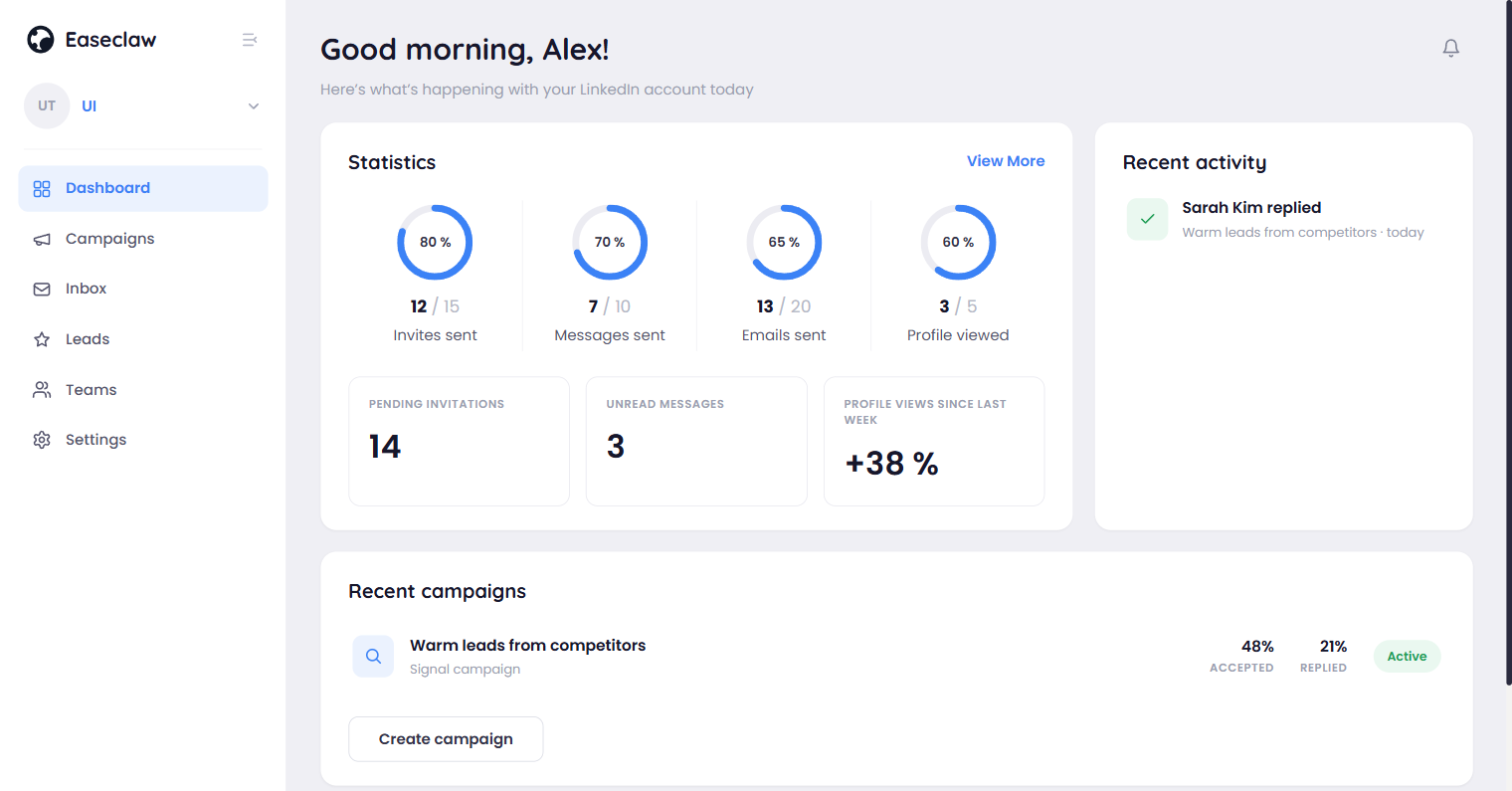
What EaseClaw looks like
Our product, shown with example data. There are no Gojiberry screenshots anywhere on this page, because I have not run it, and a screenshot would imply I had.

What a warm list costs, measured on our own outreach
Figures from our own ledger, not an industry study, and not a promise about what your campaigns will do. They are here because they answer the question both products are really selling an answer to.
The 17% is the interesting one. Pulling the people who engaged with a competitor is cheap and is not the hard part. Roughly one in six of them turned out to be another vendor selling into the same room, and taking those out by hand is the tax nobody quotes you for. Both of these products exist to do that removal before a message is drafted, which is why the picture of your ideal customer matters more than the sourcing. The full ledger, with the date each figure was read:
- Competitor and creator posts we pulled the engagers from: 44 posts from 14 creators. Source: EaseClaw harvest ledger, marketing/harvests/engager-ledger.json, as of 2026-09-08.
- Unique people who had engaged with those posts: 1,672. Source: EaseClaw harvest ledger, marketing/harvests/engager-ledger.json, as of 2026-09-08.
- Those engagers who were vendors selling a rival tool: 286 of 1,672, or 17%. Source: EaseClaw harvest ledger, people marked as vendors, as of 2026-09-08.
- What it cost us to pull 1,434 engager profiles: $3.37, about a quarter of a cent per person. Source: EaseClaw harvest ledger, counters for 2026-08-06 to 2026-08-10, as of 2026-08-10.
- Posts read before 125 genuine buyers came out of them: 34,116 read, 5,789 scored, 125 buyers. Source: easeclaw.com/research/buying-intent-2026, as of 2026-08-04.
The wider view is on our buying-intent research page: 34,116 posts read, 5,789 scored, 125 people who turned out to be genuine buyers, as of 4 August 2026. Real buyers are rare, which is the whole reason a tool that picks the people is worth more than a tool that sends to the ones you picked.
Questions people ask before switching
Does Gojiberry book meetings for you?
Is EaseClaw a good Gojiberry alternative?
How much does Gojiberry cost compared with EaseClaw?
Can Gojiberry send email as well as LinkedIn messages?
I searched for Gojiberry and found a survey app. Which one is this page about?
I run outreach for several people. Which of the two should I choose?
Stop building lists. Start meeting buyers.
AI outreach for founder-led B2B teams. No lists. No SDR.
Free for 7 days. Add a card to start, cancel any time before day 7 and you pay nothing.